Powering Up Britain?

This week the UK Government launched its Powering Up Britain plan to deliver both energy security and the transition to Net Zero. The plan is wrapped in political rhetoric about sticking it to Putin by not using his gas, and backed up by more detailed supplementary documents.

My high-level assessment: if we could wind back the clock 30 years,this might be a good time to talk about developing new technologies such as Small Modular Reactors Carbon Capture and Storage, pumping the CO2 captured from fossil fuel powered electricity generation into the caverns beneath the North Sea whence those (Great British) fossil fuels came.

Why if we could wind the clock back 30 years? Because these “exciting” new technologies DO NOT EXIST at the scale required and it might easily take this long to develop them to that point. If we keep on with business as usual while we wait for the (Great British) boffins to save us from impending doom we will be, quite simply, in a world of pain. The climate is collapsing before our very eyes and we are reaching tipping points in this collapse that we did not expect to see for decades.

Quite simply, we cannot afford to wait. We need to act now with the resources that we do have at our disposal today. Fortunately, they are prodigous.

Before we worry about Powering Up Britain, we need to Power Down Britain . Quite simply, the less energy we use, the less we have to generate from renewable sources. Then we can Power Up by using currently available technologies such as wind and solar, supported by investment in developing better storage and a smarter grid to move the energy from where it is generated to where it is needed, including cooperation with our windy and sunny European neighbours.

By all means let’s invet in developing technologies such as CCUS and Direct Air Capture of CO2, but let’s not wait until they are ready to get started. We simply DON’T HAVE THE TIME.

Why reducing meat consumption is a key part of tackling climate change and biodiversity loss (but we don’t all need to go vegan).

It is now generally accepted (outside the White House) that human-induced climate change represents a clear and present danger to the survival of human civilisation as we know it. In 2018, the Intergovernmental Panel on Climate Change reported that global greenhouse gas emissions need to be reduced to net zero by 2050 to avoid the threat of runaway climate change. As a result, governments around the world have been moving at varying speeds to translate this imperative into legislative and policy changes and practical action.

The conversation about reducing emissions usually centres around three main areas: reducing emissions from electricity generation, from buildings, and from transportation. But there is a fourth area that requires addressing if we are to successfully meet the 2050 deadline and that is emissions from food and land use. In fact, the issue of food and land use sits at the intersection of the three great global challenges of our time: climate change, how we are to feed an ever growing human population that is predicted to number 10 billion souls by the end of the century, and how to halt, and preferably begin to reverse, the ongoing sixth mass extinction in the history of our planet that has seen 200 species of vertebrate animals become extinct in the last 100 years along with an unknown number of invertebrates (unknown as these creatures often go extinct before their existence is able to be catalogued by science).

 Let’s look at the issue of food supply first. 29% of the Earth’s surface is land (the other 71% being ocean): a total of 149 Million square kilometres. Of this land, 71% is classed as habitable land, as opposed to glaciers (10% or 15 Million km2, 90% of which is the land area of Antarctica), or barren land (19%: deserts, beaches, rock outcrops, etc). Of this. 50% (51 Million km2) is agricultural land and 37% (39 Million km2) is forests. A staggering 80% of this total global stock of agricultural land is used to either keep, or grow food for, livestock. What is more, the livestock that utilise all this land only account for 20% of the total calories consumed by human beings: yet another example of the 80:20 rule (the Pareto principle to economists) in action. With global population predicted to increase from 7.7 Billion in 2019 to 10 Billion by the end of the 21st century, the world’s stock of agricultural land is going to come under pressure to produce more food. Given that the 20% of this land that grows crops for human consumption and produces 80% of the calories is 16 times as efficient (4x the calories from ¼ of the land) than the 80% that produces animal products, logic would suggest that a rational world would increase food production by repurposing some of the 80% from livestock to growing crops.

However (spoiler alert), ours is not a rational world. Between 1960 and 2013, global population increased by a little over 200% but meat consumption increased by 500%. In addition to there being more people on the planet, those people have on average got richer, and rich people eat more meat than poor people. This seemingly insatiable demand for meat has led to “innovations” in livestock production that are bad news for biodiversity. Firstly, livestock production has become more intensive: in the place of extensive outdoor grazing systems have come rearing sheds and feedlots, the construction of which has led to vast areas of land being concreted over. Secondly, the production of food for these housed livestock has also intensified: the biodiverse pastures of extensive grazing systems have been replaced by rye grass monocultures that have been developed by plant breeders to respond vigorously to large amounts of inorganic fertilizer to produce the vast quantities of forage required, supplemented by cereals such as wheat, barley and maize that are grown in a similar manner. When intensification can do no more to increase production, the only way to further increase the production of livestock to meet the ever-growing global demand is to create more agricultural land by encroaching on some of the 37% of the world’s land that is covered by forests. Deforestation, especially of old growth primary forest, is disastrous for biodiversity. Tropical rainforests, which are being felled at an unsustainable rate to provide food for cattle or grow crops such as palm oil, cover around 2% of the world’s land area but are home to some 50% of the world’s plants and animals.

Livestock production accounts for around 15% of global greenhouse gas emissions, and land use change, of which the conversion of forest to farmland is a major element, a further 12%. Worldwide, trees and forests absorb around 25% of total greenhouse gas emissions so it is not hard to see that reducing this forest area, creating more emissions in the process, in order to add to the 15% of emissions produced by livestock is a bad idea. If the loss of biodiversity and the increase in climate change-inducing emissions were not enough, the destruction of primary forest habitats has been linked to the emergence of new species-jumping diseases such as Covid-19 and yet the growth in meat consumption and the felling of forests to create new farmland to produce livestock to satisfy this demand continues unabated. Ours is not a rational world (see above).

Taking all the above into account, it is not hard to see that, if we are to stand a chance of tackling the three existential crises of climate change, biodiversity loss and global food supply, worldwide consumption of meat needs to dramatically reduce and in the interests of equity and sheer mathematics, those richer countries whose citizens consume up to 10 times as much meat as those of poorer nations, and where there is an obesity epidemic that threatens to reverse the decades-long trend of increasing life expectancy, need to lead the way.

Does this mean that all of us in the western world need to adopt a vegetarian or vegan lifestyle in the interests both of our own health and that of the planet? Not necessarily. The EAT-Lancet Planetary Health Diet is a global reference diet for adults that is symbolically represented by half a plate of fruits, vegetables and nuts. The other half consists of primarily whole grains, plant proteins (beans, lentils, pulses), unsaturated plant oils, modest amounts of meat and dairy, and some added sugars and starchy vegetables. The diet aims to provide the level of nutrition and mix of foodstuffs that optimizes outcomes for both individual and planetary health whilst being compatible with achieving the UN’s Sustainable Development Goals.

Of course, what is missing in this article so far is any mention of animal welfare or the moral and ethical dimension of the decision to adopt a vegetarian or vegan lifestyle. This is intentional: much has been written about these considerations elsewhere and my aim has been to make the case for reducing meat consumption for quantifiable reasons to do with climate change, biodiversity loss and maintaining a global food system that can address these issues whilst being capable of feeding 10 Billion people in the not too distant future. A consequence of the extensification of livestock production will be an increase in animal welfare but that is not the motivating factor behind the scenario presented here, on the basis that people who are concerned about animal welfare are more likely to have already adopted a vegetarian or vegan lifestyle.

So what might this global food system look like? To start with, a dramatic reduction in meat consumption will lead to less land being required to rear and feed livestock. Given the fact that land growing crops for human consumption is able to produce calories 16 times as efficiently as land growing animals, and a global population of 10 Billion represents an increase of around 30%, it stands to reason that not all the land currently used for livestock will be required for growing crops. Following a regime like the Planetary Health Diet still requires a certain amount of livestock production but the remainder will be available for planting new forests or creating new wilderness areas: in short to give back to the non-human species with whom we share the Earth some of the habitat that humans have destroyed. How people are persuaded or coerced to reduce their meat consumption remains to be seen but it is likely that persuasion in the form of education will only go so far and that a certain amount of coercion via manipulation of the pricing mechanism for animal products is almost certainly going to be required. This could either take the form of demand side measures, such as some form of “meat tax”, or measures to restrict supply, such as production quotas and regulations banning certain intensive animal-rearing practices. The effect of both these approaches will be to raise the price of meat products, leading to a fall in demand. There are all kinds of socio-economic issues that will need to be addressed such as protecting the livelihoods of small farmers and preventing rural depopulation (other than where this would be beneficial in establishing new wilderness areas) but these will mainly require transitional measures to support the shift from a high volume/low value model of livestock production to a low volume/high value one. In addition to reducing the amount of meat in our diets, we need to urgently consider where the remaining plant-based ingredients come from. The practice of shipping and flying food around the world needs to stop, or at least be significantly reduced. We are beginning to see a return to shopping locally and eating seasonally, although work is needed to make this more than a middle-class preserve. Food poverty continues, shamefully, to be an issue even in the wealthiest societies and policy measures are needed to ensure that good nutrition, along the lines of the Planetary Health Diet, is available to everyone, regardless of income.

In conclusion, if humanity is to tackle the triple threat of climate change, biodiversity loss and starvation, there needs to be a significant reduction in meat consumption, starting with the world’s richest nations. Breaking the link between income levels and meat consumption would help ensure that future economic development in poorer countries is genuinely sustainable. In addition to the reduction in meat consumption and livestock production making a significant dent in the 15% of global emissions that are attributable to the sector, as growing crops for human consumption is so much more efficient in terms of calories produced per unit of land, feeding a growing global population on a predominantly plant-based diet would allow land to be made available for afforestation or wilderness creation, thus increasing both biodiversity and the capacity of forest ecosystems to absorb carbon dioxide from the atmosphere, further mitigating climate change.
Pandemic 2 – Where do we go from here?

Today the UK enters its sixth week of what is being termed “lockdown”, although that term to my mind over dramatises the situation as the restrictions, whilst they have a basis in law (The Health Protection (Coronavirus, Restrictions) (England) Regulations 2020 and corresponding legislation in Wales and Scotland), are being enforced primarily through a combination of personal behaviour change reinforced by peer pressure, and relatively light-touch policing rather than by troops on the streets and checkpoints with uniformed officials demanding “papers please”. Whatever we call it, the past six weeks and the threat that hangs over them have had a profound impact on our national psyche.

Following a burst of panic buying in the early stages, primarily it seemed of pasta and toilet rolls, when retailers and their supply chains struggled to keep up, life in Lockdown Britain seems to have adjusted remarkably quickly and smoothly to the new normal. Of course, the impacts are not shared evenly by everyone, no matter how much it might seem that this time we really are all in it together. The experience in affluent commuter villages where furloughed executives enjoy 6pm “quarantinis” over the fence with neighbours whilst their children play happily in large gardens following a day of enriching educational activities and home baking sessions, is a far more easy and pleasant one than the very real hardship being experienced by many cooped up in cramped and inadequate accommodation, trying to juggle work and caring responsibilities, manage their own or a partner’s mental health issues or living in the shadow of abuse, all whilst trying to cope on 80% (if they are lucky) of an income that was never enough in the first place.

Increasingly, the national conversation is beginning to turn to when we might expect to see the restrictions eased and some semblance of normal life restored. There have been media reports that, during the Prime Minister’s absence recovering from what seems to have been a serious illness as a result of Covid-19 infection, the Cabinet is split between those Ministers who are advocating a swift return to normality in order to save the economy and those who counsel caution and remaining in lockdown until the medical and scientific advice points unequivocally towards a lifting of controls. Those media commentators hoping for a bullish response from the PM on his return must have been disappointed by the cautious and measured Boris Johnson who appeared in front of the cameras in Downing Street on the morning of his first day back at work https://www.bbc.co.uk/news/uk-52439348

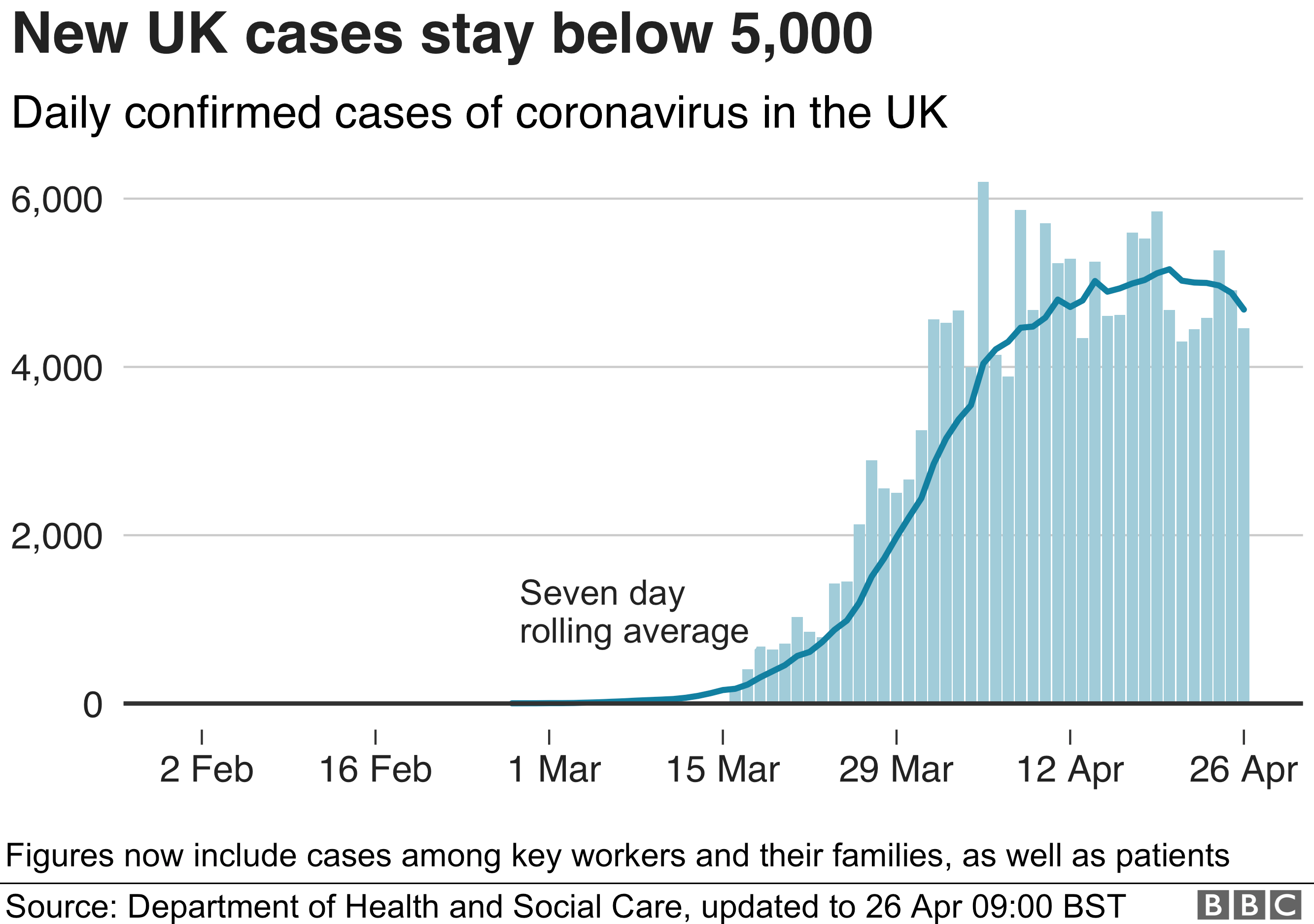
However fast or slow the exit from lockdown may be, the latest figures from the Department of Health do seem to suggest that both recorded new cases and deaths have passed the peak, even if there is no sign of a rapid descent down the curve.

Chart showing number of new confirmed cases of coronavirus in the UK has dipped below 5,000 for 5 of the last six days

It is clear that at some point, and possibly sooner rather than later if pressure continues to mount on the Prime Minister from business leaders and their parliamentary champions, the country will begin the transition back to normality, even this proves to be a slow process rather than a binary switch https://www.theguardian.com/world/2020/apr/22/uk-will-need-social-distancing-until-at-least-end-of-year-says-whitty

This is an appropriate time to reflect on what are the lessons and experiences from the past six weeks that we can take with us into the future.

One thing that is abundantly clear is that what has been referred to as the “global pause” is just that: nothing has fundamentally changed as a result of Covid-19, there has just been a temporary interruption to normal life. The world remains on track towards a disastrous level of global heating and the sixth mass extinction that has seen species and their habitats around the world vanish at an unprecedented rate continues unabated.

What this hiatus has done is give us a moment of enforced reflection to consider what is really important and how certain some of the old certainties are after all. Recent opinion polls in the UK show that the public want to see the Government tackle climate change with the same urgency as has been seen in its response to the coronavirus. This means that any recovery needs to be kickstarted by some form of green stimulus package – a nationwide programme of retrofitting the millions of homes that currently lack decent insulation, thus reducing carbon emissions and tackling fuel poverty would be a good start – rather than bailing out the oil companies and airlines. Certainly, having spent billions of pounds in propping up the economy, any return to the “there is no magic money tree” narrative will lack a certain amount of credibility, even if we have yet to see the obvious and almost inevitable corollary to increased levels of public spending, which is higher levels of taxation, being presented to the British public by a Conservative Chancellor. The switch of large amounts of manufacturing capacity over to making PPE and ventilators for the NHS, demonstrates how a comparable re-tooling and re-skilling could switch capacity in “dirty” industries to the products that will be needed for any Green New Deal – wind turbines, heat pumps and insulation, for example.   The pandemic and the resulting global pause has brought us to a point where we can reassess what we want the future to look like. We can either opt for a return to business as usual or we can choose a path towards a different future, one in which nurses, delivery drivers and fruit pickers continue to be seen as key workers and valued accordingly; a future in which the working day does not need to be preceded and followed by an hour or more stuck in traffic or crammed into a standing room-only commuter train; a future in which our worth is determined by who we are rather than by what we own and one in which we value community and human contact all the more for having been forcibly deprived of them.

On the other hand, we can allow a Government, spurred on by the vested interests and corporate lobbyists, to repeat the mistakes of the “recovery” that followed the 2008 financial crash when the banks and other institutions whose mistakes a wrongdoing had caused the crisis were handed a bailout that was paid for by a decade of austerity inflicted on the most vulnerable in society and a freeze in public sector pay that slashed the living standards of the same people who are now being hailed as national heroes.

There is no getting away from the awfulness of the Covid-19 pandemic and its impact on people’s lives and livelihoods as well as the appalling number of lives lost. The challenge we now face as a society is how to construct a future that is a fitting memorial to those we have lost so that 2020 goes down in history as a key turning point in the history of humanity.


Fruitcakes, Loonies and Climate Change Deniers

The UK Independence Party and its guffawing figurehead Nigel Farage are predicted to make substantial electoral gains in both the Local and European elections that are being held on 22nd May.

While much attention has been focussed on the pontifications of some of its more unreconstructed members on immigrants, women and same-sex marriage, UKIP’s environmental and energy policies show all the hallmarks of having been jotted down on the back of a beer mat as the minutes of a late night meeting in the back room of a Home Counties pub of a focus group consisting of Daily Mail readers and assorted other swivel-eyed loons.

The assertion by Oxfordshire-based UKIP councillor David Silvester that last winter’s devastating floods were divine retribution for the legalisation of marriage for gay couples [1] turns out to be not much less well founded in science than many of the party’s other policies.

The UKIP 2014 Energy Policy is subtitled “Keeping the Lights On” [2]. Having read the document, many will come to the conclusion that “The Lights are on but No-one’s Home” might be a more apt description.

The paper starts with a dig at wind farms, quoting the fact that one particular day in 2010 the contribution of wind to the UK’s energy consumption was 0.04%. Whether that figure is true or not, it is seriously out of date give that there was a 35% increase in installed generation during 2013. If one-off figures for the situation on a single day are to be quoted, then on 21st December 2013, wind generation accounted for 17% of the nation’s total electricity demand [3].

The document then goes on to repeat the myth that wind energy requires 100% conventional generation backup so we are paying twice for every megawatt-hour of wind generation. In reality, all the power stations on the grid – conventional or renewable – provide backup to one another and no new plants have to be built to backup wind power.
By page 2 the focus group had got another round in and were really getting into their stride. “There are increasing doubts about the theory of man-made climate change” they opined. Such doubts may emanate from the lobbyists employed by oil companies and the likes of Lord Lawson’s avowedly sceptical Global Warming Policy Foundation but the scientists of the IPCC feel that they can be 95% confident that human activity is affecting the climate [4] (up from 90% in their previous report). The proportion of articles in peer-reviewed journals that take the contrary view is something like 1 in 9,000 [5]. So, if there are increasing doubts, they are not to be found among those who understood the question.

The party also gives a nod to the idea that more CO2 is a good thing as it stimulates plant growth before launching into some purple prose extolling the benefits of fracking for shale gas – under the heading “safe and clean fracking” – the clincher for UKIP voters of course being that this is good British gas and not the nasty foreign stuff.

The policy concludes with a summary of “What We Should Do”. The list, which would be laughable if it were not for the terrifying thought that many people will believe this stuff, having fallen for Farage and UKIP’s “good old fashioned British Common Sense” shtick, consists of cancelling all subsidies for renewable energy, stopping wind power development, keeping coal-fired power stations, repealing the 2008 Climate Change Act, urgently assessing shale gas potential, urgently building gas-fired generation capacity and basing energy strategy on coal, gas and nuclear.

A better recipe for disaster it is hard to imagine.

References:
1. http://www.bbc.co.uk/news/uk-england-oxfordshire-25793358
2. http://www.ukipmeps.org/uploads/file/energy-policy-2014-f-20-09-2013.pdf
3. http://en.wikipedia.org/wiki/Wind_power_in_the_United_Kingdom
4. http://www.climatechange2013.org/images/report/WG1AR5_SPM_FINAL.pdf
5. http://desmogblog.com/2012/11/15/why-climate-deniers-have-no-credibility-science-one-pie-chart

Inconsistent and Indefensible

The Government today announced that there would be no more public subsidies for new onshore windfarm developments.

It was also announced that future planning approvals for proposed wind energy developments would be placed in the hands of communities and their locally elected representatives and not dictated by Central Government.

Onshore wind is the cheapest form of renewable energy and is zero carbon in operation.

This week the Government also announced a proposal to grant additional rights to companies carrying out fracking for shale gas to extend their operations horizontally beneath the property of neighbouring landowners without the need for consent, thus appropriating the private property rights of these neighbours whose ownership is traditionally in English law seen as extending from the centre of the Earth below to the heavens above their allotted portion of England’s Green and Pleasant Land.

Licences to explore for oil and gas, including by fracking, are granted by Central Government and not the Local Planning Authority.

With the enthusiastic backing of the Prime Minister and Chancellor, a generous tax allowance (subsidy) regime has been put in place for shale gas exploration.

Shale gas, whilst less carbon intensive a fuel than coal, is still a fossil fuel, a non-renewable resource the burning of which adds to the CO2 emissions that are fuelling climate change. In the United States, fracking has been linked with environmental damage, pollution of groundwater, methane emissions, seismic events and adverse human health impacts. In the UK there is widespread public opposition to the prospect of fracking, significant protests in potential shale exploration sites such as Balcombe and Barton Moss which have led to the arrest of a Member of Parliament – Green MP and former Party Leader  Caroline Lucas – who was recently cleared of all charges.

How can any sane individual claim that the Government’s blatantly contradictory stances on onshore wind and shale gas add up to a coherent energy or environmental policy?

Of course…there is an election looming and UKIP are in town and spreading panic in the Tory heartlands. Sanity has been ditched along with all the “green crap”.

I’ve Made up my Mind – Don’t Confuse Me with the Facts

The Fifth Assessment Report of the Intergovernmental Panel on Climate Change, published last autumn contains the earnestly considered and peer-reviewed opinion of the world’s leading climate scientists that there is a 95% probability that human activity is affecting the climate.

According to research posted on quora.com Out of 617 members of Parliament:

27 have science and technology degrees
15 environment studies and geography
12 engineering and architecture
10 medicine and allied subjects

So a grand total of 64 MPs (10.3%) have degrees in subjects that that can, stretching the point a bit, be defined as “Science”. There is one sole Member of Parliament (Julian Huppert, Lib Dem MP for Cambridge) who has practised science past PhD level (he was a research biochemist).

So why is it that MPs such as Peter Lilley, Christopher Chope, Andrew Tyrie, John Redwood and David Davis along with former Thatcher Chancellor Nigel Lawson and Environment Secretary Owen Paterson feel they can present the whole climate change debate as being a finely balanced one in which the sceptical view deserves as much credence as any other?

If Education Secretary Michael Gove is so keen on restoring rigour and factual learning in schools, perhaps he should start with his Parliamentary colleagues.

He could do worse than setting them homework that includes enrolling on a MOOC (Massive Open Online Course) such as the Future Learn course run by the University of Exeter on “Climate Change: Challenges and Solutions” that I am currently studying. The current course has closed to new entrants but I am sure they will run it again if Mr Gove asks them to. It only takes a few hours a week, there are no entry requirements and the course explains the fundamental science behind planetary systems and how human activity is affecting them.

Of course, a little knowledge is a dangerous thing. But profound ignorance among those responsible for making policy on these issues is potentially lethal. For all of us.

Is Dredging the Answer?

January 2014 was the wettest since records began, according to figures from the Met Office1

The persistent heavy rainfall has led to flooding across many parts of the UK, some of the worst being in Somerset where the communities of the Somerset Levels have been inundated since Christmas with so prospect of relief in sight.

The situation in the Levels represents a microcosm of the plight facing populations in many low-lying areas of the world as sea levels rise as a result of climate change. These are communities founded on land the very edge of what is habitable and therefore uniquely vulnerable to any small change in the delicate balance of climatic factors that made settlement possible in the first place. In the case of the Somerset Levels, much the area actually lies below sea level and is an artificial landscape created by drainage and water management since Roman times2 The Levels, like the East Anglian Fens on the other side of the country, are dependent on drainage and pumping to prevent them reverting to their natural state of marsh and swamp with areas of open water and isolated islands of dry land, such as the Isle of Ely in the East and Glastonbury in the West. Other parts of the country have been subjected to coastal flooding where sea defences have been breached or have been submerged beneath floodwaters where rivers have burst their banks.

There has been a bitter debate locally and in the pages of the regional and national newspapers about the supposed failure of the Environment Agency to keep up with the dredging of the main rivers that drain the Levels, thus condemning the people living there to suffer a catastrophe that should have been averted3. The ‘to dredge or not to dredge’ debate is one of those that seems simple on the surface – which appeals to politicians who like a clearly defined moral high ground that they can occupy – but that becomes more complex on further investigation. It seems common sense that a watercourse will be able to carry a greater volume at a more rapid rate if it is provides a clear, deep, straight channel than if it is silted up or partially obstructed with vegetation. Indeed, all things being equal, a watercourse in the former condition will indeed operate more efficiently as a conduit for water than one in the latter state. Therefore, is it not blindingly obvious that regular dredging is essential and, if the government agency responsible fails to carry out this work, is it not clearly guilty of appalling negligence?

The key phrase here is ‘all things being equal’. In conditions such as those currently prevailing on the Somerset Levels, the dredged and canalised watercourse and the un-dredged river with its naturally occurring silt deposits and vegetation may be equally ineffective in preventing flooding.

The problem is explained by Professor Roger Falconer, Professor of Water Management at Cardiff University:

 “To reduce significantly the peak water levels one needs to increase the hydraulic gradient, i.e. the water surface slope, and thereby increase the flow from the marshes to the sea. This will not be significantly achieved by dredging.  What dredging will do is to increase the area of flow, which will marginally increase the flow over the short term.  Furthermore, the dredged bed will rapidly readjust itself with time to the natural hydraulic conditions – over a relatively short time – and one is then back to square one, i.e. more flooding and more dredging.  Added to this one has climate change and rising sea levels, thereby reducing the hydraulic gradient even further and making the problem worse.”4

The fact is, given the vastly greater capacity of a river floodplain to hold water than the channel of the river itself, even doubling the capacity of the river is going to have  very marginal benefit in terms of flood alleviation especially if this ‘hydraulic gradient’ is small. The problem, says George Monbiot, is the way in which the upper reaches of river catchments have been stripped of their ability to mitigate the flow of water from the hills into the rivers. To address this, he says:

“That means, broadly speaking, the following:

–          more trees and bogs in the uplands

–          reconnecting rivers with their floodplains in places where it is safe to flood (and paying farmers to store water on their fields while the danger passes)

–          making those floodplains rougher by planting trees and other deep vegetation to help hold back the water

–          lowering the banks and de-canalising the upper reaches, allowing rivers once more to create meanders and braids and oxbow lakes. These trap the load they carry and sap much of their destructive energy.”5

Former Director of Friends of the Earth, Tony Juniper, agrees that we need to look at the management of whole catchments and floodplains rather than only starting to think about the issue once rivers have burst their banks. Writing in the Guardian, he like Monbiot points to the way in which the ability of the uplands to hold rainwater and slow down the rate at which it flows into the rivers has been compromised by generations of mismanagement:

“In upland areas, the degradation of peat soils by burning, drainage and the cutting of peat for fuel means that the many areas of blanket bog that clothe Britain’s hills and mountains can no longer serve their function as giant sponges that catch and hold rain. Instead, water runs off the land, exacerbating flood risk downstream.”6   

As with many instances of human interaction with the environment, cause and effect are not always linked in the most obvious way. In this case, the misery caused by the floods on the Somerset Levels, as well as in other parts of the country, may have less to do with the Environment Agency’s supposed failure to dredge the River Parrett and River Tone and more to do with farming and land management practices on the Quantock and Mendip Hills. Unfortunately, these are subtleties that do not readily lend themselves to memorable soundbites at Prime Minister’s Questions or snappy headlines for the front pages of the papers.

References:

  1. http://www.metoffice.gov.uk/news/releases/archive/2014/Early-January-Stats
  2. http://www.bbc.co.uk/news/uk-england-somerset-26080597
  3. http://www.westernmorningnews.co.uk/Commons-debate-cost-flooding-Somerset-Levels/story-20453023-detail/story.html
  4. http://www.sciencemediacentre.org/expert-reaction-to-somerset-flooding/
  5. http://www.monbiot.com/2014/01/30/dredged-up/
  6. http://www.theguardian.com/commentisfree/2014/feb/05/how-to-stop-flooding-soil-water-farming-dredging

The Davos Summit – How have we done since 2011?

Speaking at the Davos World Economic Forum in January 2011, Secretary General of the United Nations, Ban Ki-moon did not mince his words when he addressed the assembled world leaders, central bankers and CEOs on the challenges in front of them:

“For most of the last century, economic growth was fuelled by what seemed to be a certain truth: the abundance of natural resources.  We mined our way to growth.  We burned our way to prosperity.  We believed in consumption without consequences.

Those days are gone.  In the twenty-first century, supplies are running short and the global thermostat is running high.  Climate change is also showing us that the old model is more than obsolete.  It has rendered it extremely dangerous.  Over time, that model is a recipe for national disaster.  It is a global suicide pact. So what do we do in this current challenging situation?  How do we create growth in a resource-constrained environment?  How do we lift people out of poverty while protecting the planet and ecosystems that support economic growth?  How do we regain the balance?  All of this requires rethinking.” 

Dutchman Ralph Thurm’s is one of many voices calling for a renunciation of this “global suicide pact” and a shift in the mindset of business leaders from thinking of sustainability as just another set of boxes to be ticked and KPIs to report against to shareholders. Thurm calls for governments and corporate managers to lift their eyes from the obsession with measurement and micromanagement of initiatives designed to make their operations marginally less bad and embrace the definition of sustainable development that came out of the Rio Earth Summit over 20 years ago in 1992. This definition, which is often parroted without much understanding by the ‘sustainability industry’ is:

“The right to development must be fulfilled so as to equitably meet developmental and environmental needs of present and future generations.” Rio Declaration on Environment and Development: Principle 3 

In an article published at the end of 2013, Thurm observes:

What we can conclude more than 20 years after the first conference and more than 25 years after the Brundtland report is simply unsatisfactory, even more it has cemented our path to a slow death of humans on this planet.”

Thurm advocates replacing the concept of sustainability with ThriveAbility and urges business leaders, economists, accountants and statisticians to play their part in the move to a new paradigm that addresses the big picture problems of how we can collectively find a way of structuring global economic activity that is in accord with the Rio Declaration and is compatible with the long-term survival of human civilisation.

In stark contrast to this talk of an urgent need to find an alternative future for humanity, UK Prime Minister David Cameron’s address to this year’s Davos gathering was an object lesson of short-sighted, business-as-usual empty rhetoric dressed up as some kind of grand vision. The PM appeared to be pinning his hopes for the UK’s recovery on ‘re-shoring’ jobs that have in recent years been ‘offshored’ by companies seeking cheaper locations for their call centres and his new-found enthusiasm for shale gas:

There is no doubt that when it comes to re-shoring in the US, one of the most important factors has been the development of shale gas, which is flooring US energy prices with billions of dollars of energy cost savings predicted over the next decade.

Taken together, I believe these trends have the ability to be a fresh driver of growth in Europe too.

I want Britain to seize these opportunities.”

He was clear that the only way to achieve prosperity is to liberate the wealth creators from the shackles of regulation when he added:

“And above all, we need an unashamedly pro-business regulatory environment – with labour market flexibility, low jobs taxes and a willingness to pave the way for new business and new business models.”

All of which sounds worryingly like a prescription for business as usual, or certainly a return to business as it was before the 2008 crash.

Shale gas exploitation is associated with well-documented local environmental issues around land and groundwater pollution, together with risks of earth tremors and a range of other issues. It is also a fossil fuel so is represents a continuation of the problem rather than being a genuine solution. Furthermore, the US experience as documented in Richard Heinberg’s 2013 book Snake Oil: How Fracking’s False Promise of Plenty Imperils Our Futuresuggests that the volume of shale gas that is economically recoverable is significantly less than the vast amounts promised by the fracking industry’s hype. What shale gas does, however, along with nuclear power, is provide a bridge between our oil-fuelled present and a renewable future. It gives a narrow window of opportunity in which the world leaders who gather at Davos each year can decide to abandon the global suicide pact and make the shift to a future built on genuine sustainability (or ThriveAbility).

The danger is that they will instead continue to choose business as usual and it is becoming increasingly clear where that is leading.

The IPCC Report

In a blaze of media coverage the Fifth Assessment Report of the Intergovernmental Panel on Climate Change has been released. Well, almost. Someone in the IPCC’s PR team knows what they are about as the ‘Summary for Policymakers’ (realistically about as much as most people are going to get anywhere near reading) was released last Friday to give the editors of the Sunday papers time to organise thorough coverage and the meat of the report itself is out today.

One of the key headlines of the report is an increase in the level of confidence the human activity is affecting the world’s climate from 90 to 95% (about as much certainty as scientists are ever going to commit themselves to).

Other chilling (surely the wrong word in this context) highlights include:

1. Warming of the climate system is unequivocal, and since the 1950s, many of the observed changes are unprecedented over decades to millennia. The atmosphere and ocean have warmed, the amounts of snow and ice have diminished, sea level has risen, and the concentrations of greenhouse gases have increased.

2. Over the last two decades, the Greenland and Antarctic ice sheets have been losing mass, glaciers have continued to shrink almost worldwide, and Arctic sea ice and Northern Hemisphere spring snow cover have continued to decrease in extent

3. The rate of sea level rise since the mid-19th century has been larger than the mean rate during the previous two millennia.

4. The atmospheric concentrations of carbon dioxide (CO2), methane, and nitrous oxide have increased to levels unprecedented in at least the last 800,000 years. CO2 concentrations have increased by 40% since pre-industrial times, primarily from fossil fuel emissions and secondarily from net land use change emissions. The ocean has absorbed about 30% of the emitted anthropogenic carbon dioxide, causing ocean acidification.

Those are just some snippets from the first seven pages of the summary and they paint a picture of a planet whose systems have been stressed almost to breaking point by human activity. However, the IPCC scientists cannot be accused of hysteria or doom-mongering and, whilst the situation is undeniably serious, there is still time for concerted action to allow us to avoid the worst-case scenarios.

All in all, a balanced and thorough piece of science that paints an objective, if bleak, picture of the current and likely future situation and leaves no room for doubt that urgent action is required.

The response of the UK Government’s Secretary of State for the Environment? I paraphrase here but essentially: “Look on the bright side – at least you won’t have to put the heating on so often”

Climate Change – Who Do You Believe?

This article was originally published on the Sustainable Business Toolkit website in January 2013

It’s a tough call. On the one hand, there was an editorial in the Observer last Sunday that proclaimed “Now No One Can Deny that the World is Getting Warmer”

On the other hand, the Mail on Sunday, admittedly not a publication that has ever been accused of harbouring tree hugging tendencies in its newsroom, declared on the same day: “Global Warming Stopped 16 Years Ago, Met Office Report Reveals: Mail on Sunday Got it Right About Warming… So Who Are the ‘Deniers’ Now?”

That two UK newspapers published on the same day can carry such contradictory stories on the same subject of such global importance illustrates the problems faced by those who seek to communicate the facts about climate change to both political leaders and the general public and expect them to take rational decisions based on those facts.

The Observer editorial concerns the publication, in draft form at present, of the US Government’s National Climate Assessment and Development Advisory Committee’s Climate Assessment Report.
The introduction to the report is presented in the form of a ‘Letter to the American People’ and the first sentences leave the reader in no doubt about what is to come:

“Climate change, once considered an issue for a distant future, has moved firmly into the present. This report of the National Climate Assessment and Development Advisory Committee concludes that the evidence for a changing climate has strengthened considerably since the last National Climate Assessment report, written in 2009. Many more impacts of human-caused climate change have now been observed.”

The report extends to 1,146 pages of assessment compiled by a team of 240 scientists and will be subject to a review by the US National Academy of Sciences alongside the public consultation process before the final version is published later this year. There is no doubt that the content of the report is deeply disturbing but one thing that is really striking is the uncompromising, unequivocal way in which the report’s authors – representing some of the leading thinking in the field with access to the widest and deepest sets of data in existence – spell out their message: man-made climate change is real and it is affecting real people in the real world now. It is hard to believe that this report has originated in the same country that recently held a Presidential election in which the issues that 240 leading scientists describe as presenting “a major challenge for society” barely received a mention from either of the candidates, including the one who is now responsible for leading the world’s largest economy’s response.

On the other hand, the Mail on Sunday appears to have reverted to the belief that climate change is a leftwing conspiracy designed to undermine Western capitalist society, or at least house prices in the Home Counties. More particularly, the paper has seized on the fact that a report by the UK Met Office appears to suggest that there has been a slowdown in the rate of increase in global average temperatures. The facts, inevitably, are not so clear cut: the Met Office’s new projections, generated by a new computer model that the agency itself heavily caveats, are that temperatures over the period 2012-16 will be 0.43 degrees C above the average for the period 1971-2000 as opposed to the previous prediction of 0.54 degrees. Hardly dramatic or conclusive, especially when one considers that the confidence ranges for the new and old predictions are 0.28-0.59 and 0.36-0.72 degrees respectively. In addition to the fact that an increase in temperatures above the previously forecast level is well within these parameters, the model compares future temperatures to a 30-year average that itself shows a significant warming trend compared to previous decades.
An overwhelming majority of respected scientific thinking agrees that anthropogenic (man-made) climate change is a reality and has done for quite some time but, to read the popular press, one could be forgiven for thinking that the issue is still in doubt and that there is no need for politicians to take difficult decisions or for people to make changes to their lifestyles.
One of the coalition government’s new, and much applauded, initiatives on taking office was to establish an independent Office for Budget Responsibility to ensure that economic forecasting and the collation and publishing of data regarding key economic indicators are kept separate from policy-making. Perhaps it is time for an independent Office for Climate Responsibility.