Let’s Do This!

Having stumbled across some people recently who actually read these scribblings, I feel inspired to pick up my “pen” again and get back in the habit of writing stuff here.

Having come to the end of my ‘sabbatical’ (self-funded I hasten to add, not one of the proper ones that academics get) during which a lot of changes have happened (more on those to follow) I am now embracing the brave new world of working part-time in a wholly remote role in a charity that operates in a totally different field.

This old dog is about to learn a whole load of new tricks…

Ch…ch…ch…changes

On 1st January 2022, I will emabark on something I have never done before in the 30 years since I left university – an extended period of voluntary unemployment. I am going to have a sabbatical/gap half-year. My two years at the helm of CAT has been a remarkable experience but, for various reasons, it has not worked out for me on a personal level. This is through no fault of CAT as an organisation: I remain a huge fan and was delighted with my leaving gift of life membership, but after twenty three years in senior management, nine as a Chief Executive, my body, mind and spirit have been crying out for a break. I intend to return to the fray (if someone will have me) later in 2022 to lead another charity but for now, in the words of Monty Python, it’s time for something completely different.

Watch this space…

The Future of the Office

The Covid-19 pandemic and the resultant lockdown has led to the vast majority of office workers working from home since the end of March. At the time of writing, the UK Government has just announced it will be dropping its “work at home if you can” guidance to something that reflects Prime Minister Boris Johnson’s frequent encouragement to “get Britain back to work”. This is therefore a good time to reflect on the pros and cons of home working and to what extent the recent dramatic changes we have seen in working practices may become permanent.

Facebook founder Mark Zuckerberg recently grabbed the headlines with his prediction that up to half of Facebook’s 45,000-strong workforce could be permanently working from home in the next five to ten years

Whilst we might expect the likes of Facebook and Zuckerberg to be ahead of the curve when it comes to innovation, there will be many less well-known businesses outside of the world of technology that have discovered, perhaps unexpectedly, the business benefits of having staff work at home during lockdown and who will be wondering to what extent these can be embedded as the economy returns to normal. The benefits of home working for businesses are usually cited as employees who are able to have a better work/life balance being happier and more productive and the ability of companies to access a broader and more diverse pool of talent. There will be many managers and business owners who have been pleasantly surprised by how productive their remote work force has been, reflecting a longstanding view that people working from home are not really working. Furthermore, there are many workplaces in which being present in the office, often for very long hours, is an essential prerequisite for career advancement. The widespread adoption and acceptance of video meeting technology such as Skype, Zoom and Microsoft Teams has meant that fears on the part of employees that by working at home they are “out of sight and out of mind” need no longer apply.

However, at the end of the day what may have more sway with company Finance Directors than these “human” considerations are the very real cost savings that can potentially be achieved by moving all or part of the workforce to home working – for either all or part of the week – on a permanent basis. In addition to allowing for social distancing considerations as part of the “new normal”, many businesses may find that having just 20% of the workforce in the office on each day of the week will allow them to significantly reduce their office space requirements whilst allowing for the resumption of some of the social contact that many workers value as part of office life as well as those meetings that, for whatever reason, do not lend themselves to being held online.

There is also evidence that whilst some workers are enjoying the remote working experience. For those with a dedicated home office space and a garden in which to work or enjoy breaks, it has been an overwhelmingly positive experience; others, whose working environment is far from ideal or who crave the social interactions of office life are increasingly desperate to return to business as usual.

In addition to the benefits, or otherwise, to individuals and employers, there are a number of societal benefits that accrue from a long-term shift towards remote working. On a global level, the reduction in greenhouse gas emissions resulting from the lower number of vehicle movements due to there being fewer commuters are potentially significant as, on a more local level, are the associated reductions in road congestion and improvements in air quality. In the short term, these have been offset to some extent by an increase in the number of people choosing to commute by car rather than public transport due to concerns over social distancing and the risk of infection. Government investment in schemes to encourage walking and cycling will further reinforce these positive changes as well as leading to improvements in public health including  reduction in obesity levels as people become more active.

At the end of the day, it is likely that the future will herald a middle way between the extremes of business as usual and the lockdown situation of 100% home working. Just as there are both advantages and disadvantages for employees to working at home, there are good reasons why businesses might prefer to have staff in the office for at least some of the time.

Of course, business often extends beyond the doors of the office to include meetings in locations at a distance from HQ. Whilst there have been many benefits to having all meetings take place on Zoom, etc – savings on travel time and cost, venue hire and catering, as well as the wider benefits concerning emissions, congestion and air quality – there will always be some meetings that are just better done face-to-face. Similar considerations apply to conferences and training courses – whilst holding these online brings all the benefits noted above as well as the ability for conference delegates to attend only those sessions that really interest them and be in the (virtual) office the rest of the time, as opposed to the hotel bar, it is hard to replicate those chance meetings and conversations that take place outside the main auditorium or training room over lunch, in the coffee queue or waiting for the lift where contacts are made and business cards exchanged.

Looking to the future, it is likely that a new paradigm of office work will emerge with more employees being based at home for part of the week but travelling to the office on a regular basis. The Government is actively working to address one barrier to this, which is to make season tickets for public transport more flexible in order to accommodate this new way of working. Although the Government has announced that it hopes to end social distancing by Christmas, it is likely that employers will want to factor the possibility of renewed restrictions being imposed in the future into their workspace planning.

The impact that Coronavirus has had on the national psyche means that the office workforce as a whole has a unique opportunity to renegotiate the contract with employers regarding expectations about how and where office work will be performed. The prize for getting this renegotiation right is an extensive package of benefits for employees, businesses and wider society. As has been said on so many occasions during this crisis: there cannot be a return to business as usual but a transition to a new normal.


Pandemic 1 – How Did We Get Here?

The past few weeks have been like nothing any of us could have ever imagined. When reports began to come out of China in January of a new virus that had apparently jumped species from animals to humans and was spreading rapidly through the population of Wuhan, few people in the West took more than a passing interest. For those of us of a certain age, this is the fourth potential pandemic to emerge from China in the past twenty years – SARS, Swine Flu and Avian Flu were all suppose to be about to bring the UK to its knees but the most serious impact that I can recall is having to place our small backyard poultry flock under lockdown for a few months when Avian Flu threatened. This meant that, although being no stranger to the pandemic planning process stood me in good stead when it came to formulating a response to Covid-19 in both my personal and professional lives, there was undoubtedly a part of me that did not take the threat entirely seriously. After all, we hadn’t we been here before: much ado about nothing for a while and then back to normal?

That misplaced optimism soon evaporated as, along with the rest of the country, I watched, transfixed with a mixture of horror and disbelief, as the virus spread across the globe, aided and abetted by the highly connected world in which we live today. This global connectivity and the ability of the virus to cross continents within a matter of hours, hitching a ride with its human hosts via long-haul air travel, is one of many reasons why the Covid-19 pandemic of 2020 is potentially several orders of magnitude more deadly than the oft-quoted comparator of the Spanish Flu pandemic of 1918, which claimed more lives than the industrial-scale slaughter of the Great War.

The first documented case of Covid-19 infection was recorded in the UK on 31st January and exactly four weeks later on 28th February the first case not involving a patient who had travelled to an infected area overseas was recorded. By 1st March, cases had been confirmed in all four constituent parts of the United Kingdom. The UK Government announced a four-pronged strategy to tackle the outbreak: contain, delay, research and mitigate, which was explained to the public by the man who became an unexpected public figure, and one who inspired more public confidence than the politicians as people turned to the experts for reassurance, Chief Medical Officer Professor Chris Witty. Unfortunately, the ruling Conservative Party’s instinctive support for the liberty of the individual and congenital distrust of state intervention in people’s lives led to the Government’s clinging to the now-discredited strategy of allowing the virus to spread to encourage ‘herd immunity’ just at the time when the window when the “Contain” element of their response was briefly open and an early adoption of a policy of enforced social distancing might have been succesful in more or less stopping the incipient pandemic in its tracks. As it was, by the time the Government eventually announced the closure of schools on 18th March, it was effectively playing catch-up with what many institutions were already doing off their own bats. It was not until 20th March that all pubs, clubs, restaurants and indoor leisure facilities were ordered to close and tighter, legally enforceable measures to encourage social distancing were not introduced until 23rd March, a full week after the Government first began encouraging people to take these steps voluntarily. If, as Harold Wilson said, a week is a long time in politics, it is an eternity in a pandemic and we will probably never know how many lives have been lost as a result of that week when political ideology was yet again allowed to triumph over expert advice.

However, proving that principle in politics is an infinitely flexible concept, new Chancellor Rishi Sunak announced a £12 billion package of measures in his Budget of 12th March to mitigate the damage caused to the economy by the Covid-19 outbreak. This was followed on 17th March by an announcement of loans and grants to support businesses, on 20th March by the potentially uncapped Coronavirus Job Retention Scheme and on 26th March by support for the self-employed, taking the total value of support measures to nearly 3% of GDP. This is dwarfed by the £330 billion of loan guarantes underwritten by the government as part of its support to business. This represents the very type of Keynesian state intervention in the economy that the Conservatives and their allies in the right-wing press greeted with howls of derision when Jeremy Corbyn’s Labour Party proposed them in their 2019 General Election manifesto and which were subsequently roundly rejected by the electorate. Had a Labour Chancellor introduced these measures, and a Labour Government sought to curtail people’s liberty in the way that we are currently seeing in Lockdown Britain, the Conservative opposition and the press would have been shouting about socialism and whipping up public unrest and civil disobedience to thwart the Government’s “Soviet” intentions. As it is, a Conservative Chancellor and a Conservative Government have been able to introduce these measures to almost universal support from all sides of the House of Commons and the media. Politics in the UK has truly passed through the looking glass in recent weeks and it seems at times that we are living in a bizarre alternative reality where all the old certainties have been turned on their heads.


Happy Celtic New Year (1) – endings

It is widely believed that the Celtic New Year began and ended with the Gaelic festival of Samhain (“Summer’s End”) which, in the modern Gregorian calendar, falls on 31st October/1st November. The association of this time of year with the spirits of the departed has its echoes in the Christian Feasts of All Hallows/All Saints Day on 1st November and All Souls Day on 2nd November as well as in the fancy dress parties and trick-or-treatery of modern Hallowe’en festivities. This therefore seems as good a time as any to look back and reflect on the events of the past few months, a period which has seen both endings and beginnings, as befits this time of year.

I was privileged to spend nearly seven years as Director of the Bradgate Park Trust, the longest I have stayed in any one job in my entire career and could, at one stage, see my being there until retirement. A remarkable location with some world-class heritage and a team of staff who were growing into the job and a group of volunteers whose passion and commitment was second to none and continually fired my enthusiasm: Bradgate was poised for great things and we had begun to achieve some real successes and terms of conservation, events, awards and funding received. And then politics got involved.

Charities depend on their Trustees, who are almost always unpaid volunteers. Finding good people to sit on Charity Boards is a constant struggle but there are thousands of them the length and breadth of the country doing incredible work, often in difficult circumstances and on a shoestring, to ensure that their charities deliver for their beneficiaries. It is a fundamental principle enshrined in charity law that Trustees must act only in the interests of their charity, independent of all other vested interests and personal considerations. Trustees who fail to do this not only breach charity law and fail in the moral and fiduciary duty they owe to the charity’s beneficiaries but they erode public trust and confidence in the charity sector as a whole and their conduct is an insult to all those volunteers working hard and doing the right thing. I would make “perverting the course of charity” a criminal offence like perverting the course of justice in order to really stress just how important that bond of trust is and how serious the breaking of it – they are called Trustees, for good reason, being the ones entrusted with the charity’s assets, including its people, and reputation.

I have been fortunate throughout my life not to fall victim to bullying. My physical build and robustness of character have always meant that I was never the one that the bullies picked on, which is why, when it happened, it was such a shock and why I was so utterly unprepared for it. I was also taken by surprise by the subtlety and insidiousness with which bullying can happen and the shame of having to admit that I had become a victim. I have been lucky: I had the strength, and the support, to continue fighting for three long years and then, when I had finally come to the realisation that there was nothing further to be gained by fighting, to have the opportunity to walk away, and into another job, with my health and sanity, if not exactly intact then not damaged beyond repair.

So, on 31st July 2019, I walked away…

Vegan for a Month

Last week on 1st January I joined the tens of thousands of people, including celebrities such as Chris Packham and a number of MPs and Peers, in signing up to the Veganuary movement and committing to going vegan for the month of January.

Veganism is having a bit of a “moment”,  and according to The Guardian, “Many regard 2018 as the year that veganism moved out of the realms of counter-culture and into the mainstream.”

There are as many reasons for going vegan as there are vegans but most people’s motivation to make the switch, on a temporary or permanent basis, probably falls into one or more of the following categories: ethical, environmental or health-related. Of these, the ethical/animal welfare aspects are the “traditional” reason that people choose to make the change to a plant-based diet and lifestyle but the environmental benefits of veganism have probably led to the greatest number of “converts” in the past year or two, with the increasing amount of evidence relating to the negative impacts of animal agriculture. 

Campaigns such as Meat Free Mondays have been running for a number of years, and there is increasing consensus that global meat consumption, particularly in developed countries, needs to be drastically reduced if humanity is to avoid the twin perils of climate change and mass starvation as well the the loss of habitats and biodiversity associated with the felling of rainforests to enable the feeding of cattle for the beef industry and the intensification of grazing on agricultural land in other parts of the world.

There are a number of well-documented health benefits of going vegan, from a lowered risk of heart attack and stroke as a result of the lower saturated fat content of such a diet to better skin and fewer migraines.

My own reasons for trying veganism for a month probably draw on all three of these aspects, together with a desire to be more mindful about my diet. My previous diet can probably best be described as “mainly vegetarian with quite a lot of fish and the occasional bit of meat” (try putting than on a T-shirt followed by the words “…and proud”). The most useful piece of vegan equipment I have found so far are my reading glasses – vegans spend a lot of time standing in supermarkets reading the small print on the back of packets, jars and cans. This month I will be able to say that I have not put anything in my mouth that I have not thought about carefully first.

Knowing that I was contemplating Veganuary, my daughter (a lifelong vegetarian with a weakness for cheese) gave me The 28-Day Vegan Plan by Kim-Julie Hansen for Christmas. This has proved to be a great source of inspiration and recipes and, whilst I have followed her advice to “start by veganising your favourite dishes”, I have also really enjoyed trying some completely new ideas and shifting our weekly menus out of the sort of rut that I expect many people get stuck in – the same old favourites week in and week out.

I realise that I may have fallen into the stereotype of vegans never shutting up about veganism but I have really enjoyed telling people about my Veganuary experiment and seeing their reactions. I have not so far been abused or ridiculed for my dietary choices, unlike many “proper vegans” with the most common reactions so far being “why?” (fair enough when they are willing to listen to the answer) and “what on Earth are you going to eat?” (revealing an incredible lack of imagination, although I accept that my previous “mainly vegetarian, etc” diet has meant that the switch has been far easier than if I had previously followed a diet based on steak and Big Macs.)

All in all, after 8 days of a vegan existence I can say that I am definitely not bored or hungry but it is too early to say whether I feel any health benefits or what changes, if any, I might consider continuing with into February .

I am certainly not dying for a bacon sandwich…

Backpacking the Ridgeway (4) – the Eastern Half, Day 3

White Mark Farm, where the very serviceable campsite was located, takes its name from the neighbouring landmark of Watlington Hill, whose eponymous white mark was apparently cut into the hill by a local vicar who wanted to make the spire of his church appear taller than it actually was. As I did not get to view either the mark or the church, I am unable to vouch for whether this clerical landscape artifice had the desired effect or not.

The first few miles of the day continued along the disused railway line until the Ridgeway decided it was time to strike off across country and climb up and down some more rolling hills, mainly through arable farmland with some small woods adorning the hilltops. The first stop of the day was at St Botolph’s Church, Swyncombe, a building of Anglo Saxon origin dedicated to a Benedictine monk from East Anglia who died in 680AD. The best really old churches have a deep feeling of peace about them, and this was one of those, a feeling no doubt helped by the fact that the hamlet of Swyncombe seemed to epitomise the term ‘sleepy’.

Physically and spiritually refreshed, it was time to hoist the rucksack onto what were now becoming quite tight and sore shoulders and coax stiffening legs back into action. Part-way through the third day, the fact that I had not undertaken any preparatory training for this walk other than a few extended rambles with the dog, none of which had involved carrying weight, was beginning to catch up with me. Things would get worse later that day.

More rolling farmland and more beechwoods – this was pleasant enough walking but I couldn’t help but view these first few days as a warm-up for the more remote miles that lay ahead on the second half of the walk. The first three days strengthened my feeling that I had been right to tackle the Ridgeway ‘backwards’ from East to West and to travel from the neatly ordered countryside of Buckinghamshire towards the more sparsely populated parts of Berkshire, Oxfordshire and Wiltshire, littered with echoes of their ancient former inhabitants. Before long the route crossed that pinnacle of neat ordering of the countryside: a golf course.

Having safely negotiated the crossing of Huntercombe Golf Club’s premises without falling victim to any wayward tee shots, I arrived in Nuffield on the trail of one of the excellent water points dotted along the length of the Ridgeway. The tap in question was attached to the wall of the parish church and I thankfully refilled my bottles, resisting the temptation of the tea and cakes on offer inside the church.

From Nuffield, the Ridgeway makes a 90-degree turn to the west and follows the line of  Grim’s Ditch, an extensive Iron Age earthwork of unknown function that is one of a number of similar features sharing this name located across the chalk uplands of southern England. It was near the beginning of the Ditch that I encountered the only other person I  was to meet during the course of the walk who was travelling the entire length of the Ridgeway: a fellow wild camper who was walking from West to East. We stopped briefly to compare notes and exchange tales of the trail.

It was at this point that my back really started to complain with painful muscle cramps that reduced me to walking in 20-minute bursts, interspersed with frequent stops to try to stretch my way to some relief. It became clear that I was going to have to do something about this or the expedition could end up being aborted short of the halfway point. Looking at the map, it seemed that the town of Wallingford, located a mile or so off the trail at the other end of Grim’s ditch was the best bet to contain somewhere I could score some industrial strength pain relief.

I did not make a note of how long it took me to get to the end of the Ditch at Mongewell Park, but those three or four miles seemed to take forever until I was able to cache the rucksack in the bushes at the point where the Ridgeway made a right-angle turn to the south, and head towards Wallingford on an alternative footpath.

Once in town, I had two missions: the quest for pain relief led me to Boots where a helpful pharmacy assistant, once she had been assured that Ibuprofen was not the answer (“how much are you taking?”, “British Army dose: 800mg, would kill a civilian but it’s not touching it”) kitted me out with some Co-codamol. Having washed these down with a cup of coffee, a pasty and a bun in Greggs, it was time to tackle the second mission and find somewhere that could sort out the power bank I had brought along for my phone and which did not seem to be offering any power, despite being fully charged.

If you ever bemoan the fact that mobile phone shops are taking over our town centres in unparalleled numbers, I can recommend a trip to Wallingford, which appears to be the only market town in southern Britain that does not share this blight of modern living. Ordinarily, I would rejoice in the fact that the good people and small traders of Wallingford had resisted this particular scourge, but on this occasion I could really have done with a Vodafone or EE shop, a Carphone Warehouse or a Phones4U, all of which seem to appear in every high street in every town in the land. But not in Wallingford they don’t. There was, however, a rumour of a little shop that sold secondhand video games and fixed phones. Unfortunately nobody seemed certain of the exact location of this underground technology emporium so I had to do several more laps of Wallingford town centre until I tracked it down. It is embarrassing to report that the issue with the power bank was my failure to operate the on/off switch. However, I feel vindicated by the fact that it took the phone repair man a good 10 minutes to find it, so well was it camouflaged.
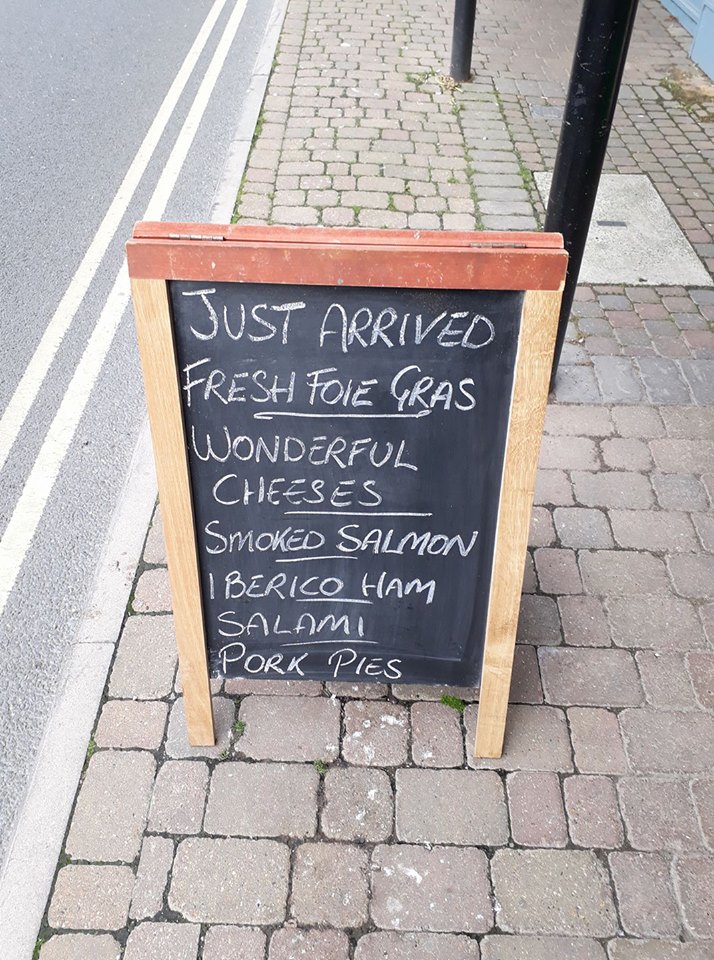
Wallingford blackboard

But no phone shops

With the drugs starting to take effect, it was time to retrieve my pack from the hedge where I had dumped it and attempt to make up some lost time.

Having got over its ‘up and down every hill in the Chilterns’ phase, the Ridgeway now proceeded to wander sedately along by the Thames in a very pleasant fashion.

I soon realised that I was not going to make it through the conjoined towns of Goring and Streatley and out into the open countryside before nightfall and so decided that what my back really needed was a proper bed for the night.

As dusk fell I plodded into the metropolis of Goring-on-Thames in search of a suitable place to lay my weary head, and ideally a couple of pints and a bite to eat as well.

The Miller of Mansfield struck me as an unlikely name for a pub in this genteel part of Oxfordshire but I crossed the threshold and enquired after the possibility of a room, reassuring the receptionist that I was both able to foot the bill and less disreputable than I appeared. She very helpfully moved a few bookings around to accommodate me and I decided to quit while I was ahead by declining her hesitant offer of a table in their very smart restaurant and reassured her that I would be quite happy to eat in the bar but that I would have a shower and make myself presentable first, so as not to upset their very smart South Oxfordshire clientele. Not for the last time, it struck me that it was possible to get away with looking like a tramp in these parts so long as one talked posh and it was to be a recurring source of amusement to watch people view my approach with a certain amount of trepidation or disdain, only to visibly relax when it turned out that the tramp spoke just like they did.

Having polished off the “Selection of Home Cured Meats & Pâté, Smoked Cheese, Pickled Onions, Gherkins & Malt Bread (large) washed down with a couple of pints to help the Co-codamol work its magic, it was time for bed.
Backpacking the Ridgeway (2) – The Eastern Half – Day 1

Most people, it seems, walk the Ridgeway from West to East and that is how the official Ridgeway National Trail guide book is written, so naturally I decided to do the walk ‘backwards’ from East to West. This was not entirely out of sheer perversity: I quite liked the idea of walking away from civilisation to arrive at Avebury and its stone circle on the Autumn Equinox, so the walk took on something of a pilgrimage-like quality. Doing the route this way also meant that Nicola could pick me up at the end and we could spend the weekend with our daughter in Salisbury before travelling on to see eldest son in Plymouth by way of a gentle few days’ touring Dorset and Devon.

Anyway, before any of that there were 90 or so miles (it is very hard to find a definitive figure) of Ridgeway to be walked and Avebury seemed a long way away as Nicola and her friend Julia set me down in the layby on the B489 at the foot of the first hill.

I don’t like walks that start with a steep climb and prefer a few gentle miles for heart, lungs and legs to get into the swing of things, feet to settle into boots and final adjustments to be made to rucksack straps before tackling the first hill. Still, since the official start line of Ivinghoe Beacon was at the top of this hill, the only way was up. One sharp 240-foot climb later, I was across the start line and officially walking the Ridgeway.

The beauty of backpacking a multi-day walk with a view to wild camping rather than using camp sites or other accommodation is that you are free to stop wherever the mood takes you and a suitable patch of ground presents itself. In practice I always find that I have a deadline by which I have to complete the walk and this means that, in order to meet this deadline, there is a more or less strict schedule for every day of the walk in order to avoid the situation of having to make up extra miles on tired legs on the final day or two.

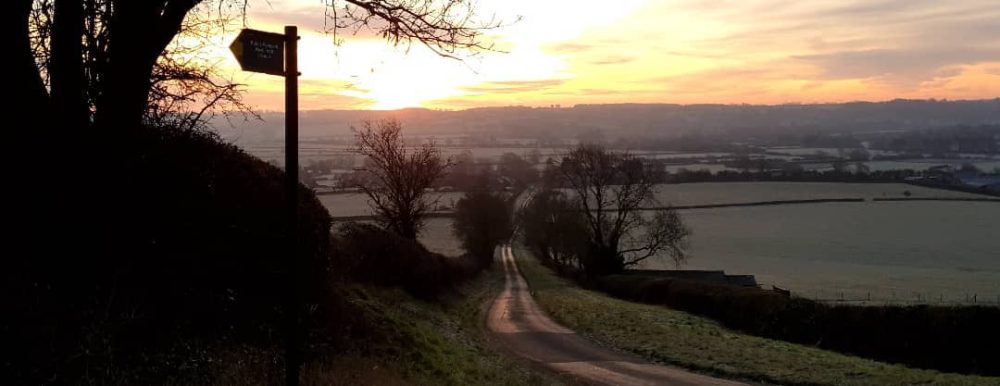
Sign day 1

The target for the end of the first day was to be Wendover with a view to finding an overnight bivi site on the inviting (on the map anyway) open but wooded ground of Bacombe Hill.

The route soon entered what was to become a very familiar landscape of chalk grassland and Beech woods typical of the Chilterns countryside and, to the eyes of one more accustomed to the acid soils and Oak woodland of Charnwood Forest, a landscape full of unfamilar plants in unaccustomed cololurs – all the flowers seemed to be shades of purple.

The first day was, in view of the fact that I didn’t get going until 1pm or so, scheduled to be a short day – 12 miles instead of the average daily mileage of 17 or so planned for the next four days. At the time of the Autumn Equinox the sun rises around 7am and sets twelve hours later so I had six hours in which to complete the day’s allotted mileage and find a suitable place to spend the night before sunset: not a blisteringly fast pace but not too much time to stand and stare either.

After a pleasant afternoon of trying to relax into the rhythm of the walk – which always takes a while – and enjoying the views over the Hertfordshire and Buckinghamshire countryside (the Ridgeway, being mostly on the ridge, is good for big landscapes), I negotiated my way through the town of Wendover and found myself at the foot of Bacombe Hill: time to look for somewhere to bed down for the night.

Having done all of my previous wild camping on the open moorland of places like Dartmoor and the Brecon Beacons, I was a little wary of camping wild in the lowlands so close to settlements. Certainly that first evening I prioritised discretion at the expense of comfort and spent an uncomfortable night in an extremely discreet, well camouflaged  location amid the thorn scrub on the lower  slopes of Bacombe Hill.

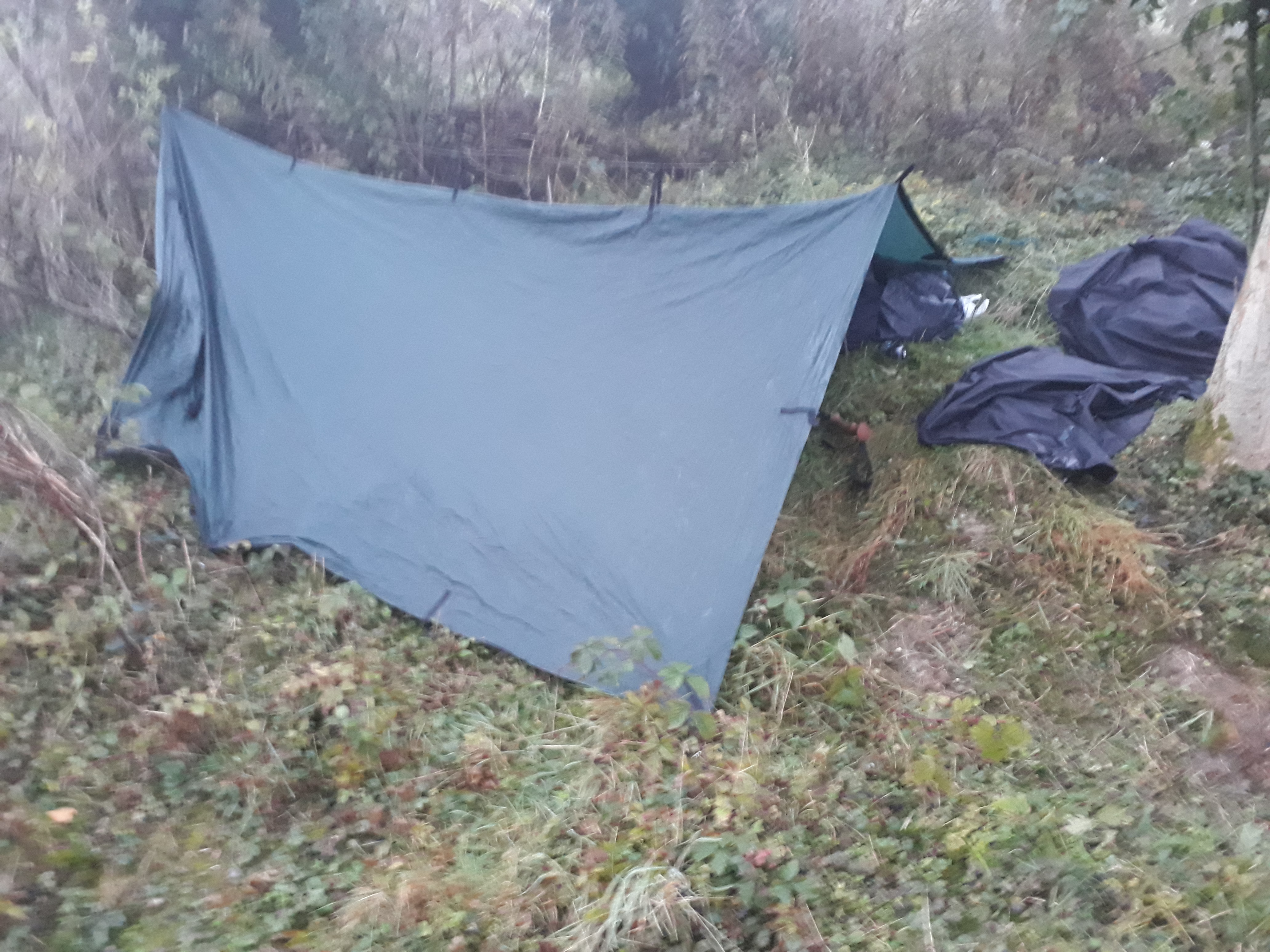
Basha night 1

The beauty of camping on the trail rather than having to divert to find overnight accommodation is that you don’t have to walk wasted miles at the beginning and end of the day and the beauty of using a tarp rather than a tent, apart from the saving in weight, is that you can pitch it in no time at all.

So, in no time at all, the basha was pitched and dinner was cooking; the first night’s fare being boil in the bag vegetable chilli from the MoD’s range of culinary classics – a cheeky little 2004 vintage that I found at the bottom of a box. Still perfectly edible so I dread to think what preservatives it contained.

Quite often the only way to find out if a site is level or not is to get into a sleeping bag, at which point the ground which looked “flattish, it’ll do” when pitching starts to feel like it is on a 45-degree slope but it is now dark and too late to do anything about it. Still, I was outdoors in a warm sleeping bag with a full stomach and the first day’s walking behind me and life was good.

Backpacking the Ridgeway September 2017 (1)

Image

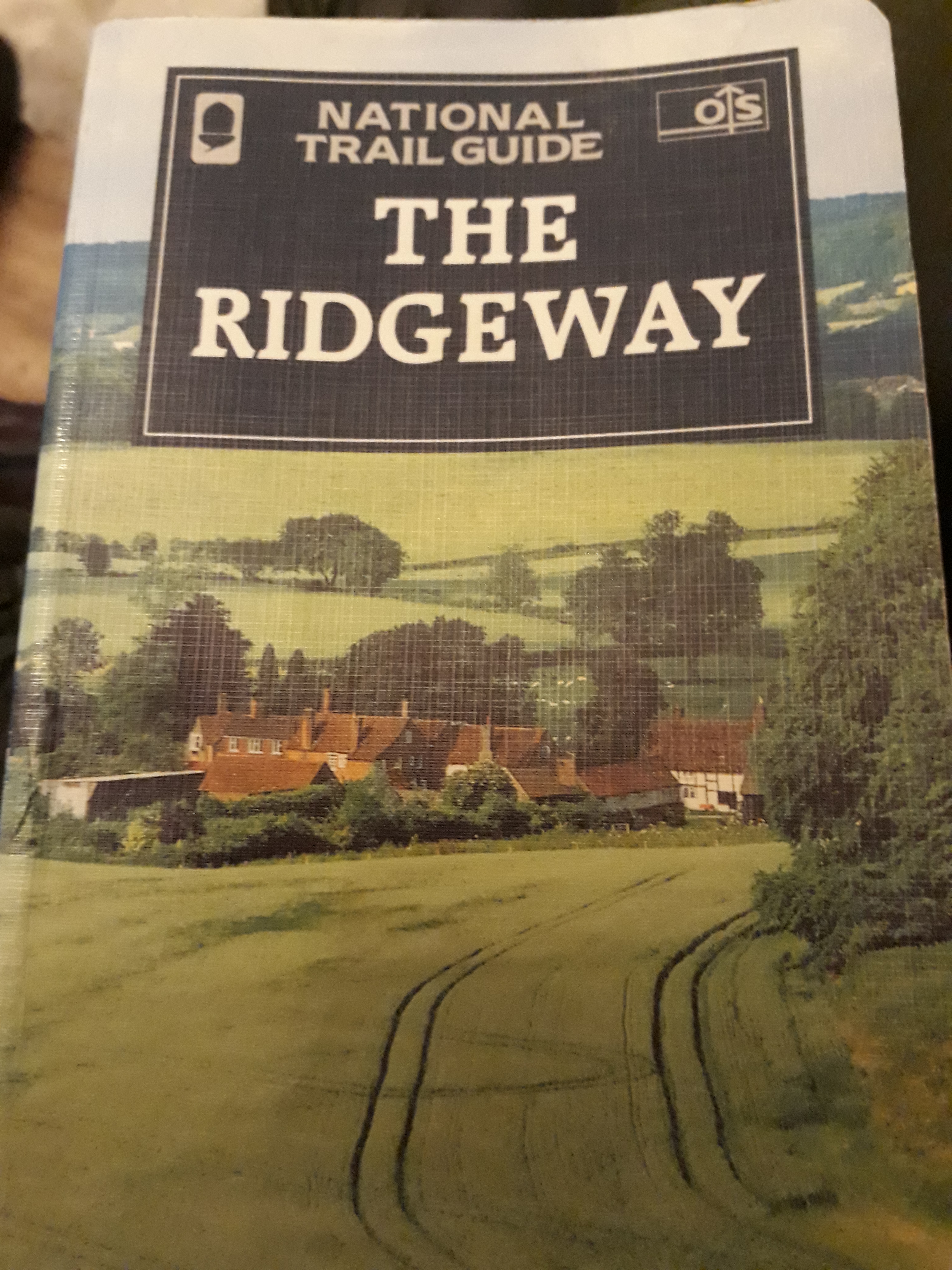
The Ridgeway is an 85-mile long trail that follows the chalk ridge from Ivinghoe Beacon in Hertfordshire, through parts of Berkshire and South Oxfordshire before finishing at Avebury in Wiltshire. It follows ancient trade and drove routes and is reputedly the oldest road in England, if not the whole of Europe. As befits this status, it passes through landscapes that are punctuated by relics of our Neolithic and Bronze Age past including many barrows and hill forts. The Ridgeway is designated as a National Trail and I first came up with the idea of backpacking it several years ago, encouraged by a half-day spent walking the Oxfordshire section once when Nicola was visiting a friend in Didcot. This year, following a particularly trying period at work, I booked two weeks off at the end of September with the idea that I would spend the first week doing the walk and then we would spend the second week touring the West Country via two of our children in Salisbury and Plymouth.Guide book

Planning and Preparation

Having decided that I would aim to wild camp on at least some of the five nights I would be on the trail, I turned to Google to see what advice the internet had to offer as regards the feasibility of this approach. As the general gist of the accumulated wisdom of the worldwide web was “go for it”, the next step was to assemble some suitable kit.

Previous experience of labouring up and down hills carrying heavy weights had taught me that, in view of my advancing years and lack of training, less would definitely be more when it came to putting together a kit list. I reasoned that, as this would be a lowland walk in autumn as opposed to a mountain walk in winter, I could cut a few corners in the interests of keeping the pack weight down, the first of which would be to manage without a tent and instead bivvy using a tarp shelter pitched on the walking poles to which, after years of mocking other walkers who used them, I had become a committed convert. I borrowed a 3m x 3m DD tarp from Son #2 who uses it with a hammock, so it came complete with generous lengths of para cord attached to each corner. This, together an unmatching pair of cheap walking poles and a handful of tent pegs, would do for accommodation. The beauty of this approach is that, instead of having to be carried all day, the “tent poles” are in productive use 24 hours a day and the rest of the “tent” weighs less than 1kg.

Having decided that my 35-litre daysack would enforce a bit too much frugality for a 5-6 day trip and that my 85-litre Army bergan would be overkill, my rucksack of choice was a 60-litre budget Eurohike number left over from the kids’ DofE days. Continuing the low-budget theme, cooking equipment was a basic screw-on gas burner purchased from an army surplus store 15 years ago, a couple of gas canisters, a pair of cheap mess tins from Go Outdoors, plastic KFS set, plastic bowl and trusty old British Army plastic mug.

Sleeping bag was a Vango 2-season lightweight down number teamed with a full-length Thermarest mat and lightweight groundsheet.

In terms of food, I decided to allow for a couple of pub or chip shop stops when passing through civilisation and to carry sufficient food for the rest of the trip. I discovered I still had a couple of meals’ worth of MOD-issue “boil-in-the-bag” rations left over from previous expeditions and a trip to Go Outdoors for more “boil-in-the-bag” meals and to the local Co-op for instant porridge sachets, cereal bars, tea bags and hot chocolate powder completed the catering procurement, apart from a couple of tins of Spam to be fried when needed to provide the ultimate morale-boosting breakfast indulgence when on the trail.

Water is an issue on the Ridgeway which, as the name suggests, follows the chalk ridge and is therefore above the springline: naturally occurring water sources are therefore all but non-existent. Fortunately the good people at the Countryside Commission (as was) National Trails Office foresaw this problem and have arranged with farmers to provide occasional water points along the route. These are marked on the excellent Ridgeway National Trail Map produced by Harvey Maps and I had no trouble in locating any of the ones that I looked for and all were in working order. Based on an estimated water consumption of 2 litres per day, I decided that carrying 1.5 days’ worth i.e. 3 litres, would be sufficient. In the event, I could have managed with less but I prefer to err on the side of caution when it comes to water, even if it means carrying a bit more weight. Obviously, doing the walk in hot weather or using dehydrated rations will increase water requirements.

Total all-up weight of the pack, including food and water, was a little under 40lbs.


Planting

Sadly, we lost touch a few years ago but my back will be forever indebted to a lady by the name of Chrissie Mitchell who introduced me to the concept of no-dig gardening. I am sure the soil structure in the various plots I have cultivated in this way over the years has also benefited but Chrissie, my back is eternally grateful.

So when I decided that I would convert part of our lawn into a vegetable garden, whereas years ago I might have cut and stacked the turf (or simply killed it with herbicide) and then dug over the area, last autumn I simply covered the plot with back plastic and waited. A few weeks ago, I pulled back the plastic, spread half a dozen bags of soil conditioner (well-rotted farmyard manure on last year’s – I wonder what the difference will be) and then re-covered the area. If this year goes as well as last year, as the soil warms up  the earthworms will be busy incorporating the conditioner into the soil, which will just need a light forking to loosen the surface, a quick rake and, voila, instant seedbed.

This method last year gave me excellent crops of beans, peas, sweetcorn and squash. This year, I am planting last year’s bed with potatoes and planting a similar mixture on the new one.

Last weekend I did get the spade out to plant a couple of rows of salad potatoes. More dedicated adherents of the no-dig method would say that this has undone all the good work that has so far gone into preserving the soil structure and I should be growing my spuds by spreading a deep layer of manure, covering with plastic and planting through holes cut in the plastic sheet. I have tried this method in the past and have never been convinced that the loss in yield compared to the traditional method of cultivation is worth the benefits to soil and back.

Of course, all the books will say that on a small plot such as mine I should be concentrating on high-value delicate crops and not low-cost staples like potatoes and beans. The problem is, my gardening philosophy is more peasant farmer than gentleman horticulturalist and I can never guarantee how much time I will be able to devote to the garden during the summer, so robust crops that can look after themselves are a must. Added to which, I have  never been able to grow out of the fascination with the ability to plant one thing in the ground and get lots of things back. This miracle of nature delights me in a way that growing crops that involve planting one thing and getting a slightly bigger thing back never has.

Today I took advantage of another benefit of living a 2-minute walk from the office and spent lunchtime filling pots with compost and planting seeds – and I challenge anyone who commutes to do that.The sun was beginning to get some warmth in it, the birds were singing, the ducks were pottering about the lawn and a passing stag eyed me quizzically. Pretty idyllic for a Monday.