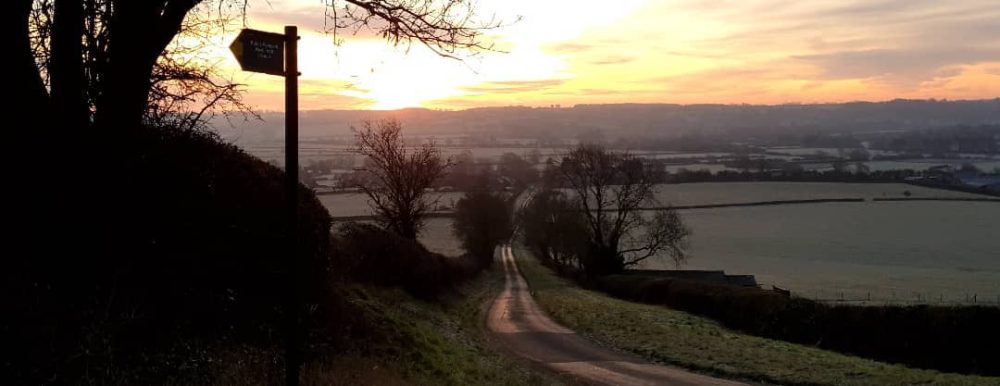
White Mark Farm, where the very serviceable campsite was located, takes its name from the neighbouring landmark of Watlington Hill, whose eponymous white mark was apparently cut into the hill by a local vicar who wanted to make the spire of his church appear taller than it actually was. As I did not get to view either the mark or the church, I am unable to vouch for whether this clerical landscape artifice had the desired effect or not.
The first few miles of the day continued along the disused railway line until the Ridgeway decided it was time to strike off across country and climb up and down some more rolling hills, mainly through arable farmland with some small woods adorning the hilltops. The first stop of the day was at St Botolph’s Church, Swyncombe, a building of Anglo Saxon origin dedicated to a Benedictine monk from East Anglia who died in 680AD. The best really old churches have a deep feeling of peace about them, and this was one of those, a feeling no doubt helped by the fact that the hamlet of Swyncombe seemed to epitomise the term ‘sleepy’.
Physically and spiritually refreshed, it was time to hoist the rucksack onto what were now becoming quite tight and sore shoulders and coax stiffening legs back into action. Part-way through the third day, the fact that I had not undertaken any preparatory training for this walk other than a few extended rambles with the dog, none of which had involved carrying weight, was beginning to catch up with me. Things would get worse later that day.
More rolling farmland and more beechwoods – this was pleasant enough walking but I couldn’t help but view these first few days as a warm-up for the more remote miles that lay ahead on the second half of the walk. The first three days strengthened my feeling that I had been right to tackle the Ridgeway ‘backwards’ from East to West and to travel from the neatly ordered countryside of Buckinghamshire towards the more sparsely populated parts of Berkshire, Oxfordshire and Wiltshire, littered with echoes of their ancient former inhabitants. Before long the route crossed that pinnacle of neat ordering of the countryside: a golf course.
Having safely negotiated the crossing of Huntercombe Golf Club’s premises without falling victim to any wayward tee shots, I arrived in Nuffield on the trail of one of the excellent water points dotted along the length of the Ridgeway. The tap in question was attached to the wall of the parish church and I thankfully refilled my bottles, resisting the temptation of the tea and cakes on offer inside the church.
From Nuffield, the Ridgeway makes a 90-degree turn to the west and follows the line of Grim’s Ditch, an extensive Iron Age earthwork of unknown function that is one of a number of similar features sharing this name located across the chalk uplands of southern England. It was near the beginning of the Ditch that I encountered the only other person I was to meet during the course of the walk who was travelling the entire length of the Ridgeway: a fellow wild camper who was walking from West to East. We stopped briefly to compare notes and exchange tales of the trail.
It was at this point that my back really started to complain with painful muscle cramps that reduced me to walking in 20-minute bursts, interspersed with frequent stops to try to stretch my way to some relief. It became clear that I was going to have to do something about this or the expedition could end up being aborted short of the halfway point. Looking at the map, it seemed that the town of Wallingford, located a mile or so off the trail at the other end of Grim’s ditch was the best bet to contain somewhere I could score some industrial strength pain relief.
I did not make a note of how long it took me to get to the end of the Ditch at Mongewell Park, but those three or four miles seemed to take forever until I was able to cache the rucksack in the bushes at the point where the Ridgeway made a right-angle turn to the south, and head towards Wallingford on an alternative footpath.
Once in town, I had two missions: the quest for pain relief led me to Boots where a helpful pharmacy assistant, once she had been assured that Ibuprofen was not the answer (“how much are you taking?”, “British Army dose: 800mg, would kill a civilian but it’s not touching it”) kitted me out with some Co-codamol. Having washed these down with a cup of coffee, a pasty and a bun in Greggs, it was time to tackle the second mission and find somewhere that could sort out the power bank I had brought along for my phone and which did not seem to be offering any power, despite being fully charged.
If you ever bemoan the fact that mobile phone shops are taking over our town centres in unparalleled numbers, I can recommend a trip to Wallingford, which appears to be the only market town in southern Britain that does not share this blight of modern living. Ordinarily, I would rejoice in the fact that the good people and small traders of Wallingford had resisted this particular scourge, but on this occasion I could really have done with a Vodafone or EE shop, a Carphone Warehouse or a Phones4U, all of which seem to appear in every high street in every town in the land. But not in Wallingford they don’t. There was, however, a rumour of a little shop that sold secondhand video games and fixed phones. Unfortunately nobody seemed certain of the exact location of this underground technology emporium so I had to do several more laps of Wallingford town centre until I tracked it down. It is embarrassing to report that the issue with the power bank was my failure to operate the on/off switch. However, I feel vindicated by the fact that it took the phone repair man a good 10 minutes to find it, so well was it camouflaged.
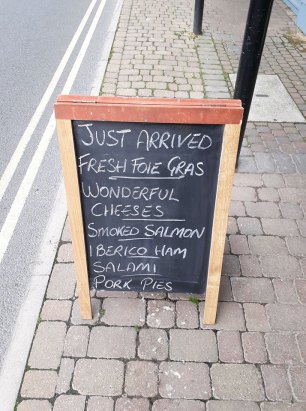
But no phone shops
With the drugs starting to take effect, it was time to retrieve my pack from the hedge where I had dumped it and attempt to make up some lost time.
Having got over its ‘up and down every hill in the Chilterns’ phase, the Ridgeway now proceeded to wander sedately along by the Thames in a very pleasant fashion.
I soon realised that I was not going to make it through the conjoined towns of Goring and Streatley and out into the open countryside before nightfall and so decided that what my back really needed was a proper bed for the night.
As dusk fell I plodded into the metropolis of Goring-on-Thames in search of a suitable place to lay my weary head, and ideally a couple of pints and a bite to eat as well.
The Miller of Mansfield struck me as an unlikely name for a pub in this genteel part of Oxfordshire but I crossed the threshold and enquired after the possibility of a room, reassuring the receptionist that I was both able to foot the bill and less disreputable than I appeared. She very helpfully moved a few bookings around to accommodate me and I decided to quit while I was ahead by declining her hesitant offer of a table in their very smart restaurant and reassured her that I would be quite happy to eat in the bar but that I would have a shower and make myself presentable first, so as not to upset their very smart South Oxfordshire clientele. Not for the last time, it struck me that it was possible to get away with looking like a tramp in these parts so long as one talked posh and it was to be a recurring source of amusement to watch people view my approach with a certain amount of trepidation or disdain, only to visibly relax when it turned out that the tramp spoke just like they did.
Having polished off the “Selection of Home Cured Meats & Pâté, Smoked Cheese, Pickled Onions, Gherkins & Malt Bread (large) washed down with a couple of pints to help the Co-codamol work its magic, it was time for bed.



 Peter Tyldesley