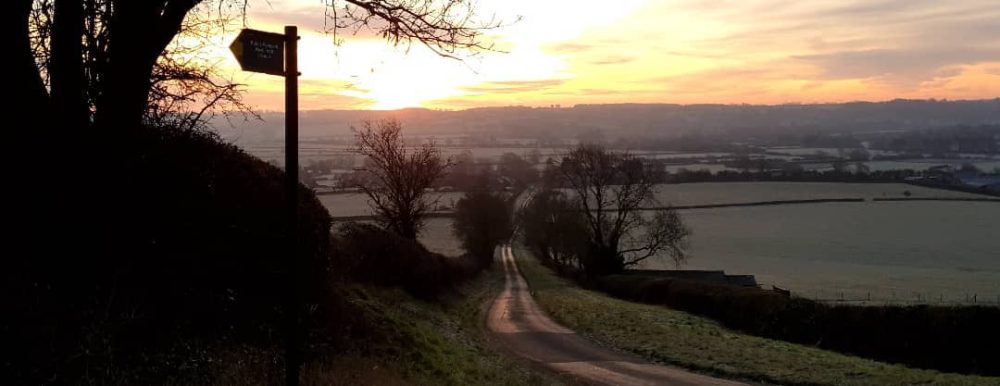
The feeling of life being good wore off a little as I discovered just how uneven my chosen bivi site actually was and I had to wedge myself into all sorts of strange, contorted positions in order to stay in my position on what had turned out to be the side of a hill, or so it felt.
Nothing seems to last as long as a bad night in a sleeping bag but eventually the sky lightened and Day 2 dawned – and a very misty dawn it was too.

Morning, Day 2
As it was 6am, it was time to get up and, rather than have breakfast where I was, I decided to continue to the top of Bacombe Hill – except there isn’t such a place: for some reason not explained on the map or in the guidebook it becomes Coombe Hill near the top – and have breakfast there, taking in the magnificent views, which the mist would reveal to me by helpfully lifting at the appropriate moment.
It would not be quite accurate to say that I sprinted up the first hill of the day but that morning probably saw the fastest start to any day of the walk: I was going to get a lot slower over the course of the next five days. I arrived at the top of Coombe Hill in short order and almost tripped over a monument…

Wikipedia says “Coombe Hill Monument is one of the first and largest examples of a war memorial erected to honour the names of individual men who fell whilst fighting for their country. The monument is an iconic Buckinghamshire landmark and a Grade II Listed monument.” It is certainly impressively large and quite imposing when it suddenly appears out of the mist.
When packing for the walk I had allocated a pot of instant porridge for breakfast each morning apart from the first day, which would be marked by Spam, likewise the last day, for which purpose I would carry a second tin for another 70 miles or so.
Spam served cold is unappealing stuff but, when sliced and fried, it is truly the breakfast of champions. I tucked in, after explaining to two curious Buckinghamshire Labradors who appeared at that moment, accessorised with Puffa-jacketed Buckinghamshire yummy mummies, that any attempt to share this ambrosia of the gods would be met with strenuous resistance at the point of a lightweight camping fork.
The mist having failed to part on schedule, I set off down the hill without the benefit of the promised magnificent views. At the bottom of Coombe Hill lies Chequers, the grace and favour country estate of the UK Prime Minister. Casual visitors are not encouraged to pop in.
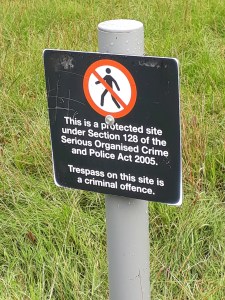
There was something about the row of “Trespass on this site is a criminal offence” signs and cameras either side of the point where the Ridgeway crosses the front drive of Chequers that made me quicken my pace. Once at the top of the shallow slope leading away from the gates, I struck a blow for the revolution by stopping for a pee up against one of the Prime Minister’s trees.
Having left Chequers behind, the Ridgeway proceeds to breach the Trade Descriptions Act by insisting on proceeding up and down every available hill in this part of the Chilterns before descending from the high ground to skirt around the outer parts of Princes Risborough.
By early afternoon, I felt I had broken the back of the day’s walking and, seeing as the September sunshine had led me to work up quite a thirst, an off-trail detour for a pub stop was called for. A quick map appreciation (as the Army calls it) revealed that the best place for this would be the village of Chinnor and a quick Google appreciation (as the Army might possibly call it now but certainly didn’t in my day) flagged up The Crown Inn as the target pub.

When I ran the tourism team at the Brecon Beacons National Park, we used to despair of the thousands of walkers who flocked to the area each year to erode the peaks but contribute nothing to the local economy, and so ever since then I have felt that I have a moral duty to right this wrong by stopping at pubs when out for a walk.
Moral duty done, I strapped the pack back on for a few miles of boring road walking before rejoining the Ridgeway, which by now was following a disused railway line that I am pretty sure wasn’t part of the original Neolithic route. After a couple of miles, the trail took an underpass under the M40 motorway where this slices through the Aston Rownant National Nature Reserve adding, may I say, not a great deal to the natural beauty of the area as it does so. At this point it became clear that my slightly over-optimistic estimate of how leisurely the aforementioned pub stop could be meant that it would be a race against time to get to that night’s campsite at Watlington before darkness fell.
It was a race that I was not to win and I arrived at White Mark Farm and its campsite, situated no more than 200 metres from the trail, by the light of my head-torch. The decision to stay on a formal campsite rather than to wild camp was one that was again based on wanting to contribute something to the local economy in exchange for my use of their scenery. There are not many campsites within easy striking distance of the Ridgeway, so it seemed churlish not to put some business the way of the most convenient one. A hot shower, another boil-in-the bag dinner and it was time to settle down for what would hopefully be a better night’s sleep; at least this time there was no questioning the flatness of the pitch.
 Peter Tyldesley